Tag

Featured

Browsing

Each month I share a real-life self-care reflection — not as a perfect example, but as a way of showing how the body responds to the life we’re actually living.

If you’ve ever felt like your body doesn’t follow the plan, these monthly updates will help you start noticing the patterns that are easy to miss in real time.

When Progress Is Quiet — But Real

February self-care could have been hastily written off as a ‘nothing changed’ month, which so easily leads to giving up, doubt or moving on to the next shiny idea.

Instead, I listened a little more closely to my body, and a different pattern emerged

At first glance, many of my daily tracking patterns looked surprisingly similar to last month.

But when I placed these three pieces of information side by side — weekly life snapshot, symptom shifts, and daily self-care tracking — a much more encouraging picture quietly emerged..

And it reminded me again of something I keep seeing:

The body responds intelligently to the life we are living.


Cycle 2 — Big Picture “Weather”

I’ve become increasingly aware that our wellbeing is influenced not only by our personal circumstances, but also by the wider emotional and environmental climate we’re living in.

February carried a subtle background hum of unrest for me. Ongoing world news — including the continued fallout from the Epstein files — conversations about the future of work and AI, and a general sense of uncertainty all seemed to add an underlying feeling of building tension that my body subtly braced for.

Nothing dramatic day to day — but very clear once I zoomed out.

As someone who followed astrology closely for many years, I also noticed the rare Neptune–Saturn conjunction at 0° Aries in the background of this period. Not something I base self-care decisions on — but fascinating to observe alongside the collective mood.

Seasonally, this cycle sat right on the edge between late winter and the earliest hints of spring. The lengthening daylight always feels uplifting, although the persistent grey, cold, wet days felt never-ending.

On the brighter days — those crisp blue winter skies — I could feel my energy and mood lift almost immediately.

Which, again, is useful feedback.


The Life Behind This Month

This cycle began under pressure.

There was an unsettling late-night incident that shook both myself and my daughter, followed by growing stress in my day job. I knew this meant that my overly sensitive body would be even more fragile over the coming weeks so tried to carefully monitor where my energy went and any early signs of tension.

Life looked quiet and no drama to report on the outside

But events in my daily life combined with the general climate created a high load month.

And those are often the months that reveal the most.

One thing became very clear:

I had to spend most of my available energy on recovery and minimising additional stress.

Bad timing — but useful information.


What the Numbers Showed
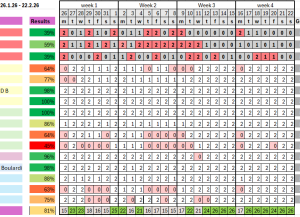
Image of February self-care tracking
My daily self-care tracker for February

When I reviewed my symptom assessments, something interesting appeared.

Despite experiencing at least as much stress — and possibly more — my overall symptom scores had improved across all body systems.

Not dramatically.

But noticeably.

This is exactly the kind of quiet shift that is easy to miss if you only look at how you feel day to day.

Because day to day, February still felt demanding.

But the body was, quietly, coping better.


Where Self-Care Was Supporting Me

This month confirmed something important for me:

Micro nervous system support was making a difference.

I also returned to several previous routines that, in hindsight, had been quietly supporting my system all along.

Nothing extreme.

Just small, consistent moments of support.

And my body responded well to it.

In fact, one of the biggest shifts this month was internal:

I rested more.

I stopped pushing.

And instead began allowing both my self-care and my work to move at a slower, more sustainable pace.

That alone reduced a surprising amount of ‘inner’ pressure.


The Subtle Wins I Could Easily Have Missed

If I had only looked at surface progress, I might have missed the real story of February.

Because alongside the stress, I noticed something I haven’t felt for quite some time:

Small glimmers of genuine anticipation for the new life I’m slowly building

Moments of vitality.

These were brief moments that bubbled up from inside me — definitely new and very welcome.

For me, these are early signals that my body now has the early reserves in place to start rebuilding.

And those signals matter.


What Fatigue Taught Me This Month

One very practical pattern also became clearer.

Fatigue tended to hit later in the day — and that directly affected my ability to follow through with evening self-care.

I also noticed something socially important:

After a full day of phone-based work, long catch-up calls with friends — although emotionally supportive — sometimes drained my remaining energy.

Interestingly, on genuinely better days, I naturally wanted more connection.

Which again told me:

My body is very clear about what it has capacity for — when I pay attention.


What Supported My Body Most

There were a few moments this month that stood out very clearly.

On several evenings I turned to my very simple sound bath practice and could feel — almost immediately — how much my body softened.

That was useful confirmation.

Alongside this, a few practical supports continue to help:

  • reducing sugar (histamine trigger)
  • smaller evening meals
  • mini nervous system practices
  • and increasingly… flexible pacing with my energy

Nothing complicated.

But each step I made was increasingly in response to listening first.


How This Is Shaping Cycle 3 (March 2026)

Looking ahead, I already know the next cycle contains:

  • longer work hours
  • increased responsibility
  • and some added home pressures

So rather than adding more, I’m adjusting early.

My focus for the coming cycle is:

  • continuing regular sound baths
  • exploring gentle wildlife gardening to support my nervous system
  • being more intentional about after-work social energy
  • maintaining the nutrition patterns that clearly help

In other words:

matching support to reality — not to ideal plans.


The Quiet Truth February Reinforced

This month didn’t deliver dramatic change.

But it did reinforce something deeply encouraging.

Even under continued stress…

Even in a high-load season…

The body can still stabilise and begin to improve when it is finally heard.

And sometimes the most meaningful progress is easy to overlook because it arrives quietly.


A Reminder

If you take anything from this month’s reflection, let it be this:

You don’t always need to do more.

Sometimes the most supportive shift is simply learning to read what your body is already telling you — and adjusting accordingly.

That is the work I am continuing to practise myself.

And I’ll keep sharing what I learn as I go.

Next Read...

When Self-Care Doesn’t Seem to Work

Last Month’s Update (January)

Create Your Personal Self-Care Menu

If healthy living feels like it works for everyone except you, the problem isn’t effort or willpower.

You’ve tried routines, food changes, supplements, habits, and advice that worked brilliantly for someone else — and then your progress stalled, reversed, or disappeared.

That experience creates doubt.

Not just about you
but about your body,
and about self-care itself.

It can start to feel like maybe your body doesn’t respond properly…
or that there simply isn’t an answer that fits.

If you’ve thought that, you’re not broken.

And you’re not alone.


What’s usually missing

When self-care keeps “failing,” most people assume they need a better method.

A better diet.
A stricter routine.
More discipline.

But the missing piece is rarely another system.

It’s the skill of reading your body’s feedback.

Your body is always responding to what you do.

Most of us were never taught how to interpret those responses.

So when something helps briefly and then stops, we assume failure instead of information.

We start over.

That cycle isn’t lack of commitment.

It’s lack of translation.


Your body is already communicating

Every self-care attempt produces signals.

Energy shifts.
Sleep changes.
Mood fluctuates.
Symptoms move.

Some signals are obvious.
Many are subtle.

Without a way to read them, it’s easy to lose trust — not just in routines, but in your own body.

Over time, people stop doubting methods.

They start doubting themselves.

That loss of trust is often the real barrier.

Not lack of knowledge.


Are you listening?

The listening skill changes everything

When you learn how to notice early feedback from your body, self-care stops feeling like guesswork.

You begin to see:

• when to continue
• when to adjust
• when to stop
• what genuinely supports you
• what your body is asking for next

The goal isn’t perfect routines.

It’s a working relationship with your body.

Because your body changes.
Your life changes.
Your needs change.

Self-care that works must change too.

Listening is the skill that allows that flexibility.

Once you have it, every practice becomes more useful.

You’re no longer chasing solutions.

You’re learning how to work with your own system.


Self-care doesn’t require a perfect life

Many people wait to begin because they believe things need to calm down first.

More time.
More energy.
Less stress.

But life rarely becomes perfectly organised before you start.

And it doesn’t need to.

This approach is built around real life — interruptions, fatigue, imperfect days included.

Messy days aren’t failure.

They’re information.

And information is exactly what this process is designed to use.


This is what we practice here

Not a rigid system.
Not the latest trend.

A listening skill you can use with any self-care practice — now or in the future.

You don’t need to fix everything at once.

You begin by learning how to listen.

Where to go next

If this felt familiar, you don’t have to figure it out alone.

You might want to explore:

Start here — learning the listening skill
How this approach works
The community space

Start Here – Discover the Missing Piece That Helps Your Body Finally Respond

If self-care hasn’t worked the way you expected, you’re not broken.

You were simply never shown how to read your body’s feedback.

That’s the skill we begin learning here.

If you haven’t read it yet, this short article explains why self-care can feel confusing — and what’s actually missing:

When self-care doesn’t seem to work for you

This page is where I share the simple answer I observed not just from my own experience but from over 20 years as a natural health practitioner.


What we do differently here

Most health advice teaches you to add more:

more routines
more changes
more information
more rules

But none of that helps if it isn’t what your body truly needs.

The work here isn’t about pushing harder.

It’s about learning how to offer support your body can actually use — and noticing how it responds.

Not someone else’s plan.
Not a perfect system.
Not a list of “shoulds.”

Simple, everyday care that matches:

your energy
your patterns
your real life

Because your body isn’t waiting for a perfect routine.

It’s waiting for the right kind of support.


personalised menu of self-care

How we begin

Instead of forcing complicated plans, you start with something much smaller:

a single, doable self-care practice that gives your body space to respond.

These are the self-care challenges you’ll find throughout the blog — gentle experiments that help you feel what truly supports you.

Not to fix.
Not to push.
Not to get it right.

But to listen and learn.

As you continue, you begin to notice:

what restores you
what drains you
what feels grounding
what your body quietly appreciates

That clarity builds slowly and naturally.

And it’s enough.


Why small steps work

Trying harder doesn’t help a body that’s already overwhelmed.

Your body isn’t a machine.
It’s responsive, aware, and constantly communicating.

When you stop guessing, small shifts become visible.

When you stop pushing, clarity grows.

This isn’t instant transformation.

It’s a steady relationship you build with yourself.

And once your body feels supported in the right way, the things you’re already doing begin to work better.

You don’t have to do this alone

If staying with self-care has been hard in the past, that’s not a personal failure.

Learning to listen to your body is easier when you’re not doing it in isolation.

There’s a free, private community where you can explore this alongside others who are learning the same skill.

A supportive space to share reflections, gain perspective, and stay connected — without pressure or comparison.

And whether you prefer to work quietly on your own or alongside others, the first step is the same.

Your First Step: The Free Self-Care Start-Up Toolkit

The Free Start-Up Toolkit shows you exactly how to choose and complete your first self-care challenge — step by step, at your own pace.

A calm, clear way to begin your journey in a way your body can truly respond to.

Inside, you’ll quickly discover how to:

🌿 Find your personal starting point
so you begin in a way your body is genuinely ready for.

🌿 Choose the right first self-care challenge
matched to your energy, needs, and real-life situation.

🌿 Listen to your body from the very first step
so you can notice what’s helping (and what isn’t) without overwhelm.

🌿 Understand the simple MSS process
so you know how to begin in a way that actually leads to results.

🌿 Feel confident and prepared to start your first challenge
with a gentle rhythm you can follow over the weekend and begin on Monday with clarity and ease.

You can complete the Toolkit in a relaxed afternoon or over a calm weekend, with short step-by-step videos and simple printables to guide you.

There’s nothing to push through.
You simply begin.

👉 Get My Free Toolkit & Choose Your First Challenge


The content shared on Make Self Care Simple is for general information and personal growth only.
I’m no longer working as a practitioner, and the ideas shared here are not medical advice or a substitute for professional care.

Everything you read here is designed to help you explore gentle, everyday self-care practices that support your overall well-being — but please always consult your qualified health professional before making any major changes to your lifestyle, diet, or treatment.

Your body is unique, and only you (with the right support) can decide what feels right for you.

©2025 Make Self Care Simple.

A private, supportive space to explore self-care alongside others — at your own pace.

If you’re here, something about this quieter, more personalised approach has probably resonated.

Many people find self-care difficult not because they lack information, but because their body doesn’t respond clearly — or responds in ways that are hard to interpret. When you’re learning to listen more closely, doing it alone can feel isolating. Doubt creeps in. You start to wonder if anything is actually helping.

This community exists to change that experience.

People join not because they want to share more — but because illness and uncertainty can quietly make life feel smaller and lonelier.

It’s a calm, private space — away from social media noise, pressure, and performance — where you can explore self-care alongside others who are also learning to listen to their bodies.

Why community helps

When your body doesn’t feel well, everyday life often shrinks.
You cancel plans. You stop doing things you enjoy. You spend more time alone — not by choice, but because your energy, symptoms, or uncertainty make it harder to engage.

Over time, that isolation can quietly turn into doubt.
You start to wonder whether you’re doing this wrong… or whether anything is really helping at all.

Learning to recognise feedback from your body is a skill most of us were never taught. Seeing how others notice patterns, respond to setbacks, or stay with small practices often brings clarity sooner — and helps soften the self-doubt that can arise when you’re figuring this out on your own.

This space is a room you can return to when uncertainty or everyday life gets in the way.
You don’t need to have the answers.
You don’t need to be doing it “right.”

You’re welcome exactly as you are.

What you’ll find inside

This free community offers a gentle place to:

  • follow along with the Self-Care Toolkit in your own time
  • share small reflections or questions, if and when it feels right
  • give and receive quiet encouragement
  • or simply read and stay connected

There’s no pressure to post, no expectation to keep up, and no “right” way to take part. Life is messy — this space is designed to fit around that.


A gentle invitation

If exploring self-care alongside others feels supportive right now, you’re very welcome to join the free community.

And if you’d prefer to continue quietly through the blog and newsletter, that’s absolutely fine too. Both paths are valid here.

 Visit the free Self-Care Community