

Curious to find out what a 28-day Non-Exercise movement challenge is all about?
If you live with mobility issues, chronic pain, fatigue, or other health conditions, exercise can feel like a loaded word — or even impossible.
But movement — in all its gentle, creative forms — is a foundation for energy, healing, and happiness.
So how do you get the benefits of exercise when traditional workouts aren’t an option?
That’s the question I had to ask myself — and it led me to discover something called NEAT movement: all the small, everyday ways we move that quietly support our circulation, mood, and metabolism.
It turns out, the magic isn’t in the gym — it’s in the little things you already do (and the ones you forgot count).
Like pottering in the garden, dancing in the kitchen, stretching during the kettle boil, or chasing the cat off the sofa for the fifth time.
Whether you use a wheelchair, live with fatigue, or just haven’t found your rhythm yet, NEAT is about meeting your body where it is — and helping it move a little more freely, one small step (or stretch) at a time.
If you have a serious health condition, always read and discuss any self-care challenge with your health provider.
Save for later? ‘Jump to Recipe’ to save/print a summary of this challenge!
Jump to RecipeWhat is NEAT Movement?
NEAT stands for Non-Exercise Activity Thermogenesis, or simply “non-exercise movement.”
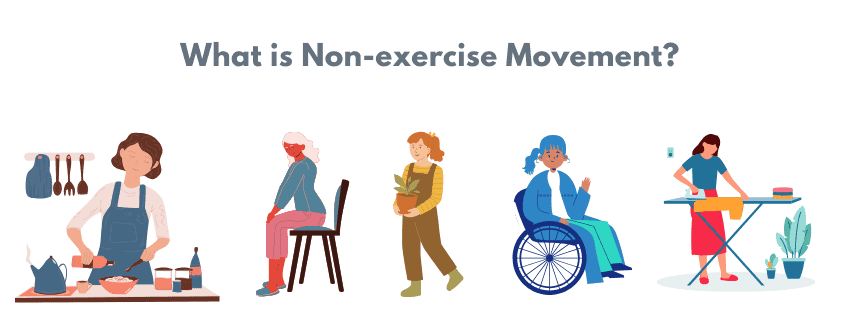
It’s all the activity you do that isn’t formal exercise — walking to make tea, stretching, tidying, or fidgeting.
Our bodies were designed for small bursts of movement all day long.
But modern life keeps us sitting — working, driving, scrolling, watching — and even those who exercise a few times a week may still spend hours sedentary.
Researchers now say that sitting is the new smoking, with serious health effects over time.
The good news? You can reverse that trend — gently and simply — with small, regular movement.
The Benefits of Gentle Daily Movement
Even a little extra movement throughout your day can make a big difference.
Here are some of the key benefits of increasing your non-exercise movement:
- Supports muscle recovery
- Reduces stress and tension
- Improves cardiovascular health
- Helps control blood sugar levels
- Reduces inflammation
- Boosts mood and mental clarity
- Burns calories naturally
- Is gentle on joints and fatigue-friendly
Because it’s low-impact and energy-efficient, non-exercise movement is especially helpful for those managing chronic illness or fatigue.
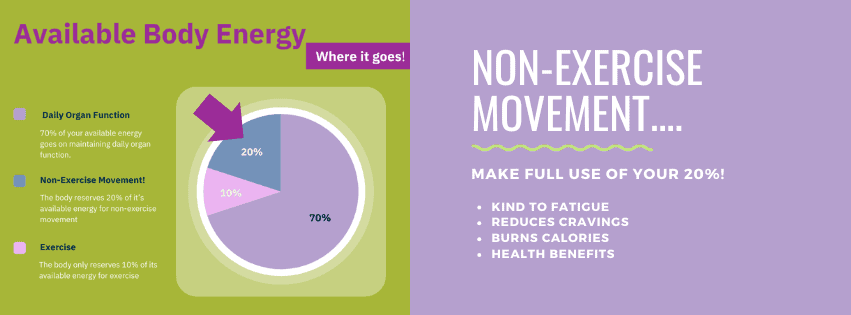
Fun fact: around 70% of your energy fuels daily body functions, 10% goes to intense exercise, and the remaining 20% is available for NEAT movement. This challenge helps you make the most of that 20%!
Before you Begin.
Take a moment to notice how active you are each day.
Maybe you move plenty on “good” days, but sit for long stretches on “bad” days.
Or perhaps you work out occasionally but spend most of the day sitting.
Wherever you’re starting from is perfectly fine — this challenge meets you there.
Tip!In this POST I share 65 Fun Non-Exercise Movement Ideas to Try For inspiration before you begin.
How to do the 28-day Non-Exercise Movement Challenge
Like any workout plan, this challenge gives you structure — but the focus is on small, realistic actions.
You can track time (minutes per day) or repetitions (reps).
Here’s how:
- Choose your movement(s) for the week or full 28 days.
- Plan how many minutes or reps you’ll do each day.
- Spread them throughout your day (5-minute bursts are great!).
- Track your progress daily.
- Increase gently each week.
- Celebrate at the end of 28 days!
Just like with regular exercise you need to set yourself a simple workout plan to follow.
See my example below.
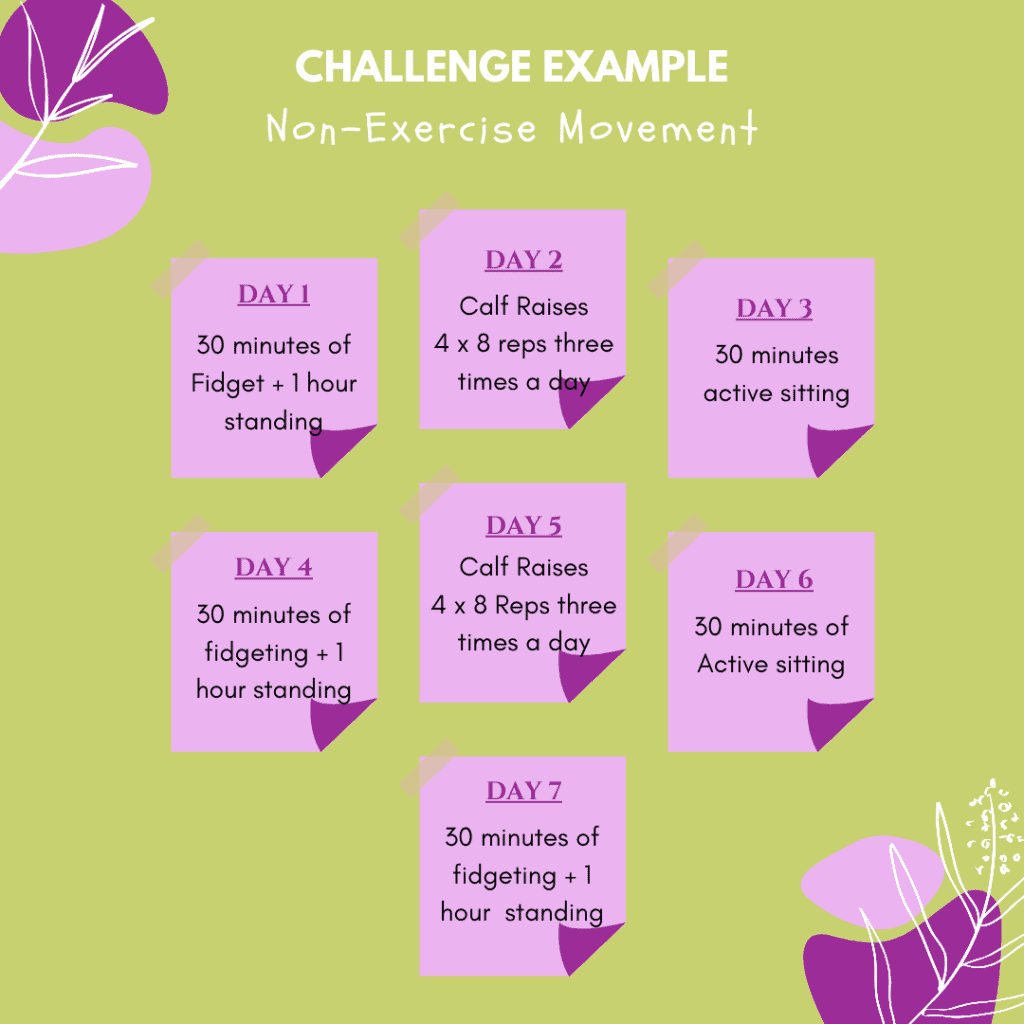
The real challenge here is being consistent – for 28-days. Don’t forget I have included FREE support such as a daily tracker for movement HERE.
Five Mini Challenges to Try
You can try one challenge each week or mix them depending on your energy.
They’re flexible — designed for “good days” and “bad days” alike.
By the end of 28 days, you’ll have built a powerful new movement habit!
Prefer a quick overview of this challenge? I’ve got you – ‘Jump to recipe’!
Jump to RecipeChallenge 1 – Fidget more this week
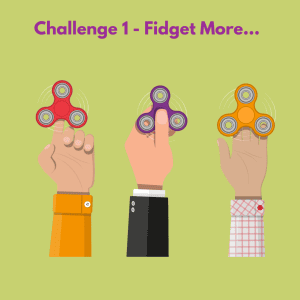
Fidgeting is a surprising hero of Non-exercise and is a perfect challenge for ‘bad’ days. Positive fidgeting can help stop or relieve bad habits and worry. Research Link.
Perfect for low-energy days. Even small fidgets (toe-tapping, shoulder rolls, finger tapping) count!
Try 5-minute “fidget breaks” during TV ads or while waiting for your tea to brew.
Challenge 2 – Stand more this week

Standing burns nearly twice as many calories as sitting and boosts circulation.
Try to stand for one extra hour each day — perhaps during calls, reading, or watching videos.
Where can you stand more in daily life?
Challenge 3 – Active sitting challenge

What if you can’t stand or walk and need to sit for hours at a time?
If standing or walking is tough, active sitting is ideal.
Set a timer for every hour you’re seated and do gentle seated movements for 5 minutes — shoulder rolls, leg lifts, side bends.
Start by aiming for 5 minutes at a time. If you know you sit for many hours each day, you might like to challenge yourself to 5 minutes of active sitting every hour.
Challenge 4 – Calf raises this week

Your Calf is described as the ‘2nd heart’, it is that important to circulation in the lower part of your body! Calf raises are simple, effective, and can be done anywhere — seated, standing, or supported.
How to:
- Sit or stand with feet flat.
- Lift heels off the floor, pause, then lower back down.
- Repeat 10–15 times a few times a day.
Benefits: improved circulation, better balance, and stronger lower legs.
Challenge 5 – Move more in daily life
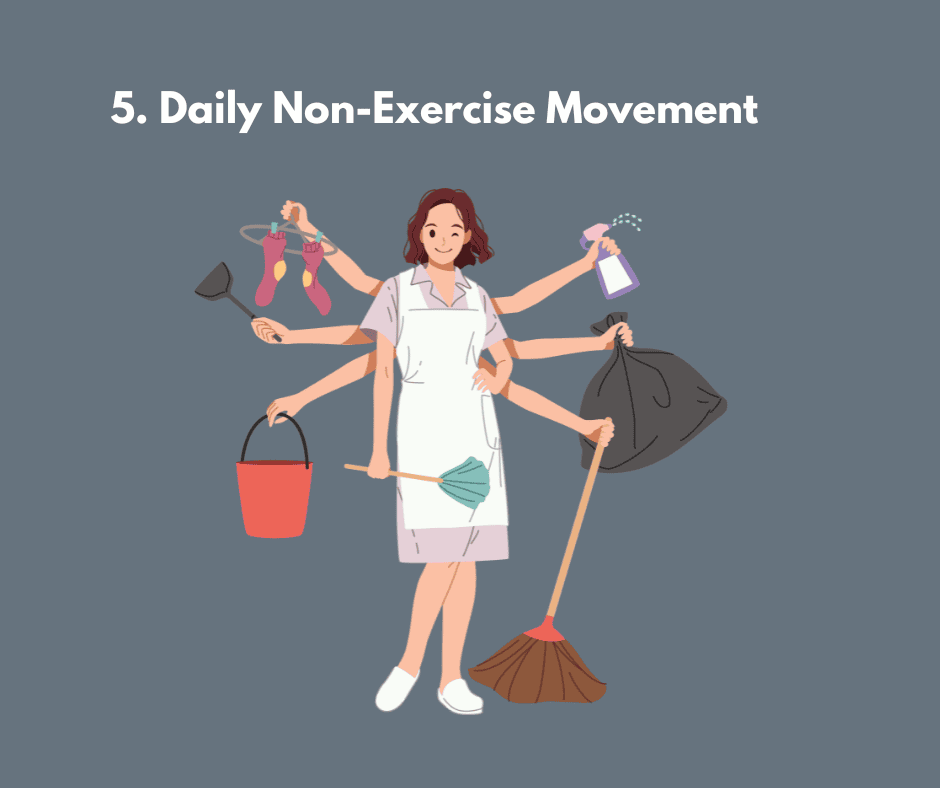
This is the final challenge and is probably the most well-known way to increase your NEAT Movement.
How many ways can you find to walk, pace, bend, and stretch in daily life?
The aim for this challenge is to add up all the minutes you are already active through normal daily life and increase the time.
This can transform your motivation to doing chores around the home!
65 Fun Non-Exercise Movement Ideas to Try
There are so many fun ways you can increase your Non-Exercise Movement (and boost your well-being) so I have listed them all together HERE
After 28-days
Notice your progress — energy, mood, flexibility, and confidence.
Even small improvements mean success!
You can repeat the challenge each month, setting a new personal best — more minutes, new movements, or better consistency.
Remember: this is about progress, not perfection.
Remember Non-exercise movement is something we should include every day for life.
Need inspiration and Ideas of what exercises to include in this challenge?

Conclusion — Keep Your Body in Motion, Gently
You’ve completed your 28-Day Non-Exercise Movement Challenge — and that’s worth celebrating!
Whether you stretched a little more, stood up a little more often, or simply noticed how your body feels when it moves, you’ve made real progress.
Remember, movement isn’t about mileage or minutes — it’s about momentum.
Every reach, roll, twist, or shuffle counts (yes, even the one where you danced to the kettle).
Even small improvements in energy, mood, flexibility, or confidence mean success.
You can repeat the challenge each month, set a new personal best, or just keep your favourite micro-moves woven into everyday life.
Because Non-Exercise Movement isn’t something to tick off and forget — it’s something to live.
It’s your gentle reminder that movement still belongs to you, whatever your starting point.
“Progress, not perfection — one small, joyful move at a time.”

Take the First Step…
We’ve all done it — promised ourselves we’d start that new healthy habit “tomorrow,” and felt oddly proud of the plan… until tomorrow never comes.
The truth is, self-care doesn’t need a perfect day — just a small, curious step today.
Your body learns from action, not intention. The Self-Care Start-Up Toolkit helps you turn what you’ve learned into action — so your self-care finally becomes real, simple, and yours.
🌿Free Self-Care Start-Up Toolkit
Self-care doesn’t need a perfect day — just a small, curious step today.
The Self-Care Start-Up Toolkit helps you turn what you’ve been reading into simple, real-world action, so your self-care becomes personal, doable, and yours.
If you’ve been thinking, “I’d love to try this myself one day…” — you don’t need to wait or wonder where to start.
The toolkit gives you gentle structure to complete your first self-care challenge in a way that fits your body and your life.
Inside the toolkit, you’ll find:
🌿 short video walkthroughs to help you choose and complete your first challenge
🌿 Printable planners, reflections, and trackers to help you stay consistent
🌿 A calm, step-by-step approach you can follow at your own pace
Prefer to explore alongside others? (optional)
Some people like to follow the challenges quietly on their own.
Others find it supportive to explore self-care alongside others.
If that feels helpful, there’s also a free, private community that sits alongside the blog and toolkit — a calm space for reflection, shared noticing, or simply staying connected while you explore.
👉 Explore the free community
Ongoing support (very light)
You’ll also receive gentle self-care reminders, new challenges, and reflections via the Make Self-Care Simple newsletter.
(Part of the Practical Self-Care Pathway — build habits that support your body’s natural balance.)
Real self-care is about listening to yourself.
Because being healthy isn’t always easy — but it can be made simple.
“Instant access—start your challenge today.”
Make Self Care Simple shares general self-care education for inspiration only. I’m not providing medical advice — always check what’s right for you with a qualified health professional.
©2025 Make Self Care Simple.
Want to Save or Print a summary of this challenge? Click on this handy ‘Challenge Recipe’!

28-Day Non-Exercise Movement Challenge
Instructions
- Assess & score your well-being (Symptoms) before you begin
- Add more Non-Exercise Movement each day for 28-days
- After 28 days Assess & score your wellbeing (Symptoms)
- Decide if you wish to add this to your Self-care Menu
Notes
- Fidget more
- Stand more
- Active Sitting
- Calf Raises
- Non Exercise Movement in Daily Life
- Choose your non-exercise movement/s for the week ahead or full 28-days.
- Plan how many minutes or reps of each movement you will do each day – try to spread them through the day.
- Track your progress each day.
- Increase the challenge gently each week. I.e. increase the minutes or reps.
- Celebrate at the end of 28 days with a healthy reward!
- Decide if you will keep Non-Exercise Movement as part of your Self-Care menu


