Tag

Heath benefits

Browsing

Curious to find out what a 28-day Non-Exercise movement challenge is all about?

If you live with mobility issues, chronic pain, fatigue, or other health conditions, exercise can feel like a loaded word — or even impossible.
But movement — in all its gentle, creative forms — is a foundation for energy, healing, and happiness.

So how do you get the benefits of exercise when traditional workouts aren’t an option?

That’s the question I had to ask myself — and it led me to discover something called NEAT movement: all the small, everyday ways we move that quietly support our circulation, mood, and metabolism.

It turns out, the magic isn’t in the gym — it’s in the little things you already do (and the ones you forgot count).
Like pottering in the garden, dancing in the kitchen, stretching during the kettle boil, or chasing the cat off the sofa for the fifth time.

Whether you use a wheelchair, live with fatigue, or just haven’t found your rhythm yet, NEAT is about meeting your body where it is — and helping it move a little more freely, one small step (or stretch) at a time.

If you have a serious health condition, always read and discuss any self-care challenge with your health provider.

Save for later? ‘Jump to Recipe’ to save/print a summary of this challenge!

Jump to Recipe

What is NEAT Movement?

NEAT stands for Non-Exercise Activity Thermogenesis, or simply “non-exercise movement.”
It’s all the activity you do that isn’t formal exercise — walking to make tea, stretching, tidying, or fidgeting.

Our bodies were designed for small bursts of movement all day long.
But modern life keeps us sitting — working, driving, scrolling, watching — and even those who exercise a few times a week may still spend hours sedentary.

Researchers now say that sitting is the new smoking, with serious health effects over time.

The good news? You can reverse that trend — gently and simply — with small, regular movement.
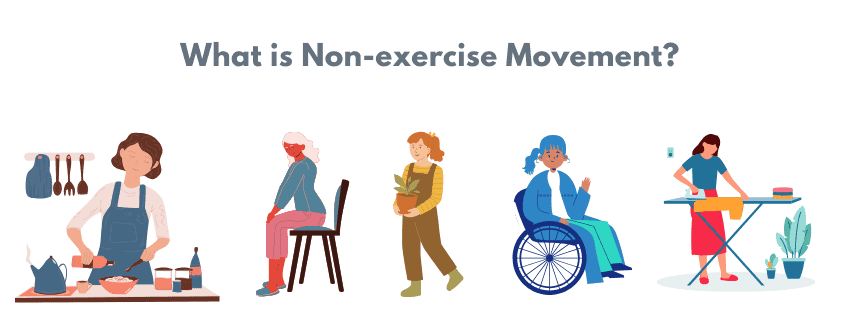

The Benefits of Gentle Daily Movement

Even a little extra movement throughout your day can make a big difference.
Here are some of the key benefits of increasing your non-exercise movement:

  • Supports muscle recovery
  • Reduces stress and tension
  • Improves cardiovascular health
  • Helps control blood sugar levels
  • Reduces inflammation
  • Boosts mood and mental clarity
  • Burns calories naturally
  • Is gentle on joints and fatigue-friendly

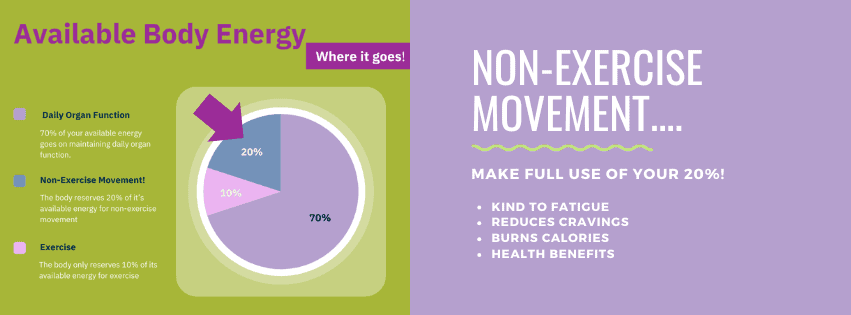
Because it’s low-impact and energy-efficient, non-exercise movement is especially helpful for those managing chronic illness or fatigue.

Fun fact: around 70% of your energy fuels daily body functions, 10% goes to intense exercise, and the remaining 20% is available for NEAT movement. This challenge helps you make the most of that 20%!

Non-Exercise Movement Challenge

Before you Begin.

Take a moment to notice how active you are each day.
Maybe you move plenty on “good” days, but sit for long stretches on “bad” days.
Or perhaps you work out occasionally but spend most of the day sitting.

Wherever you’re starting from is perfectly fine — this challenge meets you there.

Tip!In this POST I share 65 Fun Non-Exercise Movement Ideas to Try For inspiration before you begin.

How to do the 28-day Non-Exercise Movement Challenge

Like any workout plan, this challenge gives you structure — but the focus is on small, realistic actions.

You can track time (minutes per day) or repetitions (reps).

Here’s how:

  1. Choose your movement(s) for the week or full 28 days.
  2. Plan how many minutes or reps you’ll do each day.
  3. Spread them throughout your day (5-minute bursts are great!).
  4. Track your progress daily.
  5. Increase gently each week.
  6. Celebrate at the end of 28 days!

Just like with regular exercise you need to set yourself a simple workout plan to follow.

See my example below.
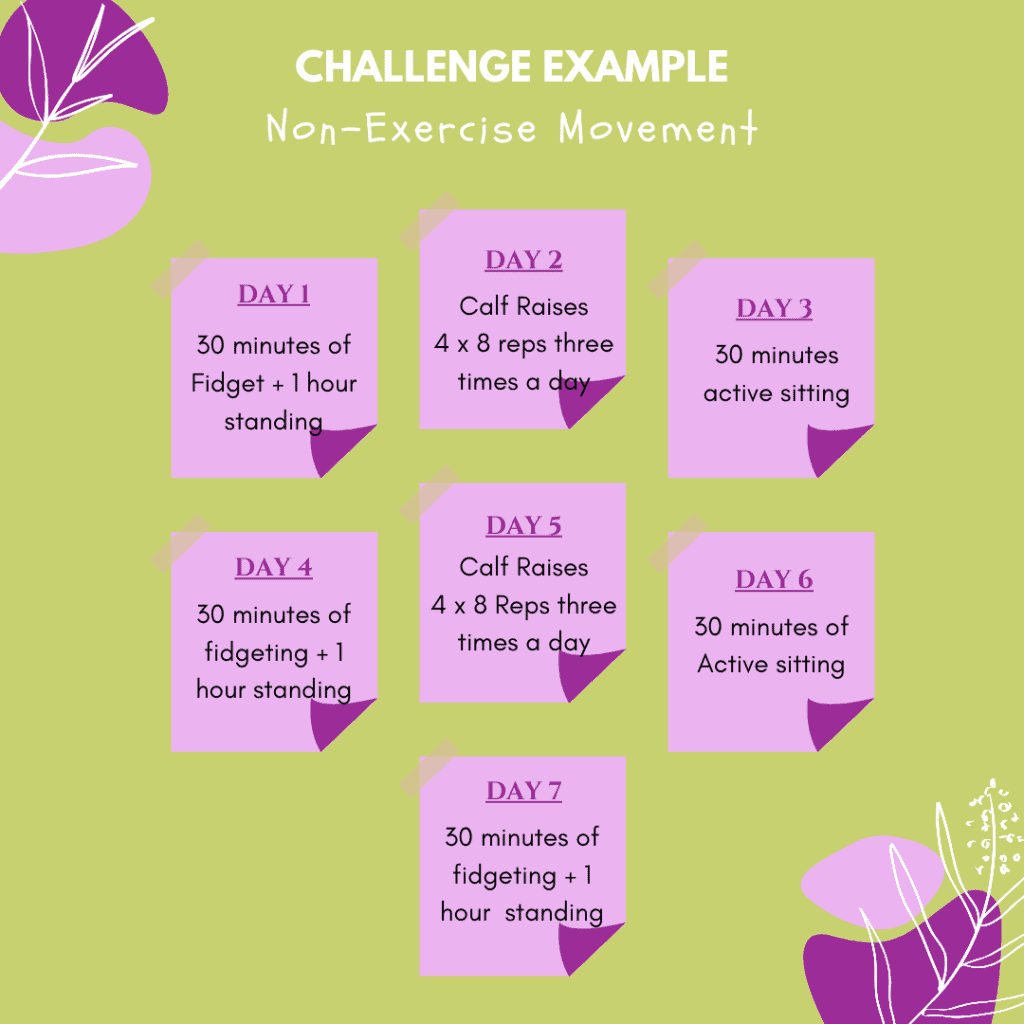
Non-Exercise Movement Challenge

The real challenge here is being consistent – for 28-days. Don’t forget I have included FREE support such as a daily tracker for movement HERE.

Five Mini Challenges to Try

You can try one challenge each week or mix them depending on your energy.
They’re flexible — designed for “good days” and “bad days” alike.
By the end of 28 days, you’ll have built a powerful new movement habit!

Prefer a quick overview of this challenge? I’ve got you – ‘Jump to recipe’!

Jump to Recipe

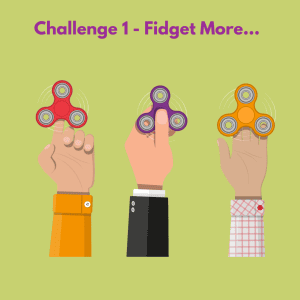
Challenge 1 – Fidget more this week

Fidget More- boost wellbeing with 28 day non-exercise movement challenge

Fidgeting is a surprising hero of Non-exercise and is a perfect challenge for ‘bad’ days. Positive fidgeting can help stop or relieve bad habits and worry. Research Link.

Perfect for low-energy days. Even small fidgets (toe-tapping, shoulder rolls, finger tapping) count!
Try 5-minute “fidget breaks” during TV ads or while waiting for your tea to brew.

Challenge 2 – Stand more this week

stand more - boost wellbeing with 28-day non-Exercise Movement challenge

Standing burns nearly twice as many calories as sitting and boosts circulation.
Try to stand for one extra hour each day — perhaps during calls, reading, or watching videos.

Where can you stand more in daily life?

Challenge 3 – Active sitting challenge

Active sitting - boost ellbeing with 28-day non-Exercise Movement challenge

What if you can’t stand or walk and need to sit for hours at a time?

If standing or walking is tough, active sitting is ideal.
Set a timer for every hour you’re seated and do gentle seated movements for 5 minutes — shoulder rolls, leg lifts, side bends.

Start by aiming for 5 minutes at a time. If you know you sit for many hours each day, you might like to challenge yourself to 5 minutes of active sitting every hour.

Challenge 4 – Calf raises this week

Calf raises - boost wellbeing with 28-day non-exercise movement challenge

Your Calf is described as the ‘2nd heart’, it is that important to circulation in the lower part of your body! Calf raises are simple, effective, and can be done anywhere — seated, standing, or supported.

How to:

  1. Sit or stand with feet flat.
  2. Lift heels off the floor, pause, then lower back down.
  3. Repeat 10–15 times a few times a day.

Benefits: improved circulation, better balance, and stronger lower legs.

Challenge 5 – Move more in daily life
Daily movement - boost wellbeing with 28-day non-exercise movement challenge

This is the final challenge and is probably the most well-known way to increase your NEAT Movement.

How many ways can you find to walk, pace, bend, and stretch in daily life?

The aim for this challenge is to add up all the minutes you are already active through normal daily life and increase the time.

This can transform your motivation to doing chores around the home!

65 Fun Non-Exercise Movement Ideas to Try

There are so many fun ways you can increase your Non-Exercise Movement (and boost your well-being) so I have listed them all together HERE

After 28-days

Notice your progress — energy, mood, flexibility, and confidence.
Even small improvements mean success!

You can repeat the challenge each month, setting a new personal best — more minutes, new movements, or better consistency.

Remember: this is about progress, not perfection.

Remember Non-exercise movement is something we should include every day for life.

Need inspiration and Ideas of what exercises to include in this challenge?

65-Fun-non-exercise-movement-Ideas

Conclusion — Keep Your Body in Motion, Gently

You’ve completed your 28-Day Non-Exercise Movement Challenge — and that’s worth celebrating!
Whether you stretched a little more, stood up a little more often, or simply noticed how your body feels when it moves, you’ve made real progress.

Remember, movement isn’t about mileage or minutes — it’s about momentum.
Every reach, roll, twist, or shuffle counts (yes, even the one where you danced to the kettle).

Even small improvements in energy, mood, flexibility, or confidence mean success.
You can repeat the challenge each month, set a new personal best, or just keep your favourite micro-moves woven into everyday life.

Because Non-Exercise Movement isn’t something to tick off and forget — it’s something to live.
It’s your gentle reminder that movement still belongs to you, whatever your starting point.

“Progress, not perfection — one small, joyful move at a time.”

Well done image in Make Self Care Simple brand colours – completion of 28-day self-care challenge
Well-done! You have completed another step towards making selfcare simple

Take the First Step…

We’ve all done it — promised ourselves we’d start that new healthy habit “tomorrow,” and felt oddly proud of the plan… until tomorrow never comes.

The truth is, self-care doesn’t need a perfect day — just a small, curious step today.

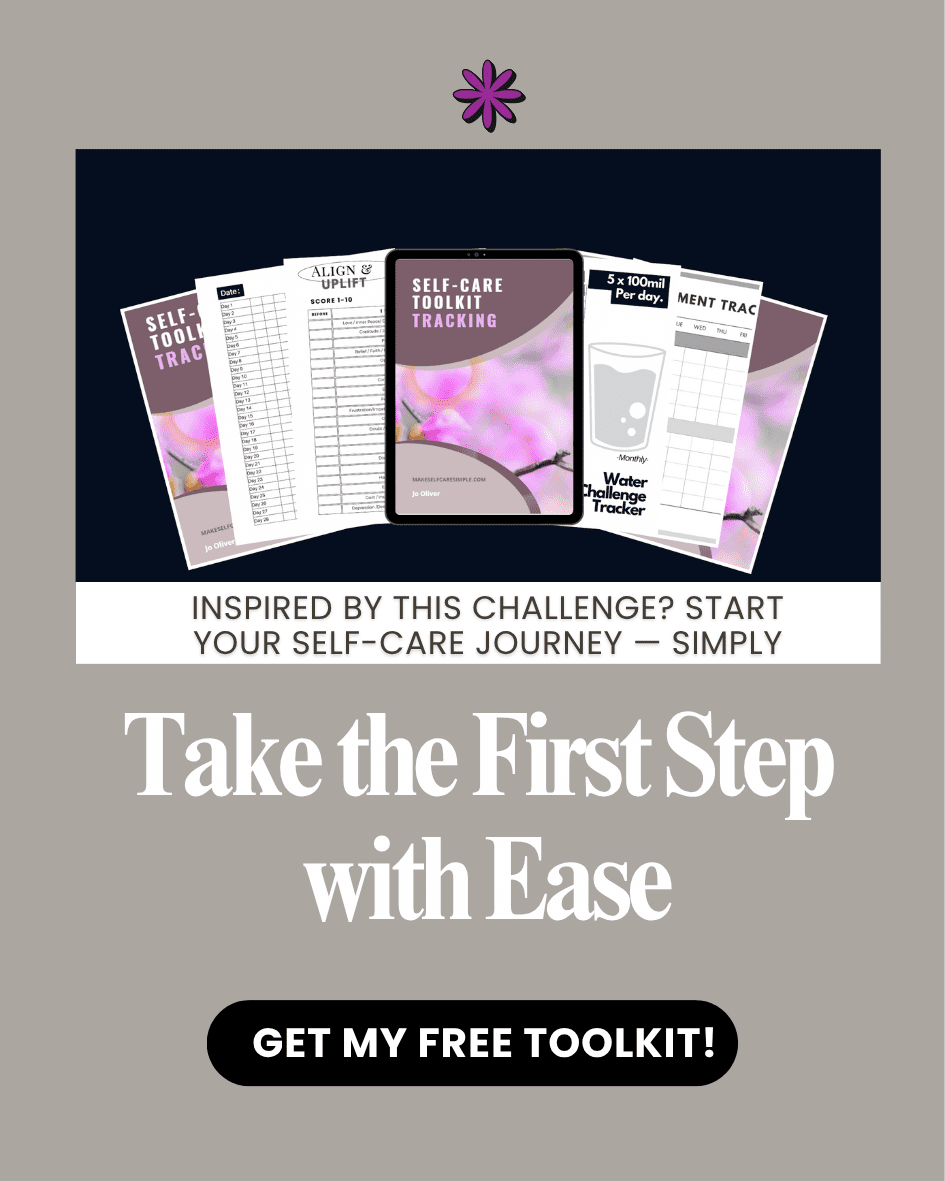
Your body learns from action, not intention. The Self-Care Start-Up Toolkit helps you turn what you’ve learned into action — so your self-care finally becomes real, simple, and yours.

🌿Free Self-Care Start-Up Toolkit

Self-care doesn’t need a perfect day — just a small, curious step today.

The Self-Care Start-Up Toolkit helps you turn what you’ve been reading into simple, real-world action, so your self-care becomes personal, doable, and yours.

If you’ve been thinking, “I’d love to try this myself one day…” — you don’t need to wait or wonder where to start.

The toolkit gives you gentle structure to complete your first self-care challenge in a way that fits your body and your life.

Inside the toolkit, you’ll find:
🌿 short video walkthroughs to help you choose and complete your first challenge

🌿 Printable planners, reflections, and trackers to help you stay consistent
🌿 A calm, step-by-step approach you can follow at your own pace

👉 Send Me My Free Toolkit

Prefer to explore alongside others? (optional)

Some people like to follow the challenges quietly on their own.
Others find it supportive to explore self-care alongside others.

If that feels helpful, there’s also a free, private community that sits alongside the blog and toolkit — a calm space for reflection, shared noticing, or simply staying connected while you explore.

👉 Explore the free community

Ongoing support (very light)

You’ll also receive gentle self-care reminders, new challenges, and reflections via the Make Self-Care Simple newsletter.

(Part of the Practical Self-Care Pathway — build habits that support your body’s natural balance.)

Real self-care is about listening to yourself.
Because being healthy isn’t always easy — but it can be made simple.
“Instant access—start your challenge today.”

Make Self Care Simple shares general self-care education for inspiration only. I’m not providing medical advice — always check what’s right for you with a qualified health professional.

©2025 Make Self Care Simple.


Want to Save or Print a summary of this challenge? Click on this handy ‘Challenge Recipe’!

28-Day Non-Exercise Movement Challenge

Reap the benefits of Movement even when your health doesn't allow you to exercise

Instructions

  • Assess & score your well-being (Symptoms) before you begin
  • Add more Non-Exercise Movement each day for 28-days
  • After 28 days Assess & score your wellbeing (Symptoms)
  • Decide if you wish to add this to your Self-care Menu

Notes

So, first read the whole challenge.
I have split non-exercise Movement into 5 sections for you to explore.
  1. Fidget more
  2. Stand more
  3. Active Sitting
  4. Calf Raises
  5. Non Exercise Movement in Daily Life
 
  • Choose your non-exercise movement/s for the week ahead or full 28-days.
  • Plan how many minutes or reps of each movement you will do each day – try to spread them through the day. 
  • Track your progress each day.
  • Increase the challenge gently each week. I.e. increase the minutes or reps.
  • Celebrate at the end of 28 days with a healthy reward!
  • Decide if you will keep Non-Exercise Movement as part of your Self-Care menu
You may like to spread this challenge over several months.
Don’t forget you can also grab your free Selfcare Toolkit HERE

Learn how dry brushing can support lymphatic health, reduce bloat, and refine skin texture in this simple 28-day routine for beginners. Your glow starts here.

The Skin You Forgot You Had

As the weather warms and the winter layers come off, there’s always that moment — you catch a glimpse of your arms or legs and realise you haven’t really seen them in months.

It’s not about vanity; it’s about rediscovery.
For most of us, the skin on our face gets all the attention, while the rest quietly hides under jumpers and jeans, waiting its turn.

That’s why this month’s challenge is all about remembering the rest of you — your arms, legs, shoulders, and back — all the skin that’s been patiently waiting for a little care.

For me, this started as a spring ritual — part reset, part reunion — a way to literally brush off winter and wake my body up again.
(And yes, dry skin brushing really does make you glow — even before the holiday tan.)

This simple 28-day practice takes just a few minutes a day, yet it leaves you feeling more alive, energised, and at home in your own skin.

Jump to Recipe

The very first question to ask is…

Will this Dry Skin Brushing challenge support my well-being?

Is Dry Skin Brushing something that could support your wellbeing needs?

Here are some signs that dry skin brushing could benefit you. 

** Dry skin brushing is not performed on the face

  • Your skin looks dull – has lost its glow
  • Your skin is dry and flaky
  • Skin is more oily
  • Poor skin texture (feel & appearance i.e. skin bumps) and tone (colour)
  • Visible pores and clogged pores
  • Ingrowing hair
  • Skin breakouts
  • Fatigue and tiredness
  • Bloating, puffiness & water retention
  • Frequent headaches
  • Recurring infections such as UTI or colds
  • Constipation

**These are good areas (symptoms) to assess and score before you start the challenge

When to avoid skin brushing

Speak to a health professional first if you are currently undergoing immune-system  treatments, have ongoing skin infections, psoriasis, eczema, open wounds, burns,skin growths or take topical steroid creams.

What is Dry Skin Brushing?

Full disclosure: There are no scientific studies to back this self care practice.

Claims about reducing cellulite have not been proven…

Now that is out of the way – what do we know about dry skin brushing?

Dry Skin Brushing has been practiced for thousands of years – all around the world

  • In Ayurvedic medicine it is called Garshana and traditionally uses a rawsilk or linen sock.
  • In Japan it is called Kanpumasatsu and uses a dry towel
  • In Chinese Medicine it uses dried fruit fibres such as a Loofah
  • The Greek & Romans used copper Strigils
  • In Native American medicine it used corn cobs
  • In Polynesian cultures they used crushed seashells 
  • And the Turks and Russians used the popular body brushing method.

Dry Skin Brushing is performed before a shower when the skin is dry. Use a dry towel, brush or loofah and brush over your skin causing a pleasant friction. You only need to do this for a couple of minutes and use a firm but not hard pressure. Then follow with your regular shower routine.

The general rule is to brush towards your heart.

** If your goal is to reduce lymph congestion (Puffy skin) see links below.

Because Dry Skin Brushing can be stimulating it is recommended to do it earlier in the day. Especially if you have sleep issues.

Honestly it is very simple to do (full instructions below) and feels great.

How Does Dry Skin Brushing Work?

When you brush your dry skin, you loosen dead skin cells, so that they can be washed off and reveal new, smooth and brighter skin cells. 

Dry skin brushing is a form of exfoliation speeding up the process of shedding old skin cells. It is thought that regular exfoliation improves skin texture and tone i.e. pink bumpy skin and enhances body lotion/product absorption.

Another aspect of detoxification is your Lymphatic system. This is like a slow moving canal carrying waste out of the body – that relies on body movement to squeeze it along the body . Old time healers believed dry skin brushing encouraged movement of the Lymph. 

Dry Skin brushing can be helpful as a regular practice if you are unable to be active most of the day. This might result in relief of puffiness and water retention much like massage.

Dry Skin Brushing also activates nerve endings in the skin which is what creates that pleasant tingling and invigorating sensation.

Preparing for your Challenge

Luckily this self care practice is simple to prepare.

You can use any of the following;

  • An existing body towel (not too soft!) long enough to do your back
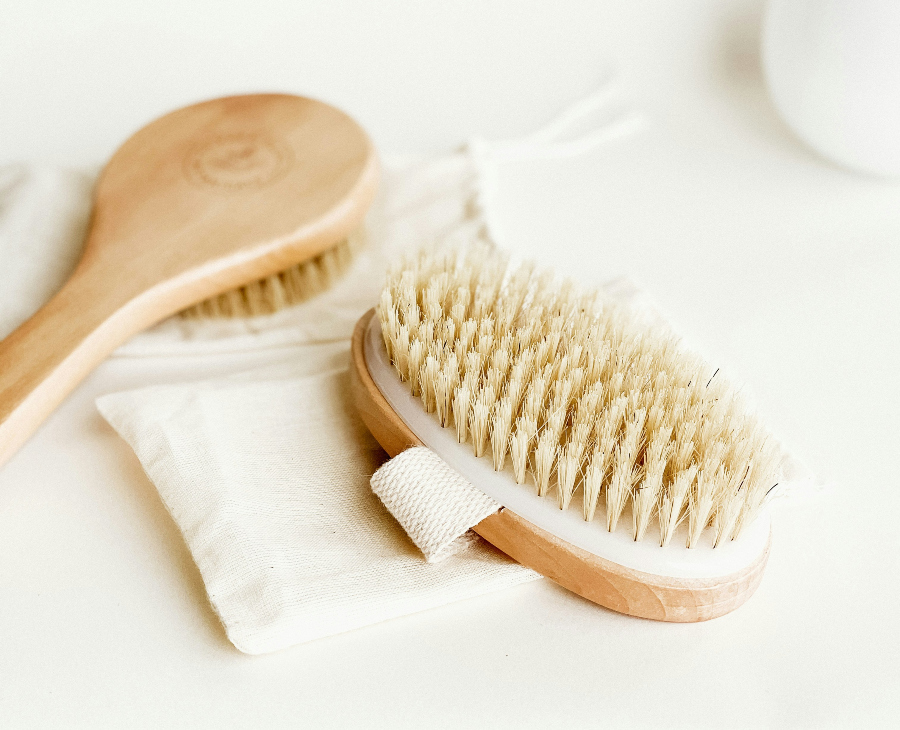
  • A Dry Skin Brush with natural bristles (detachable handles are handy!)
  • A Loofah

Optionally you can dive deeper in which type of Dry Skin Brush to use HERE

dry skin brushes

You will also need to capture details about your before and after assessments and tracking sheets to help you stay consistent.

If you haven’t already, grab my FREE Self Care Starter Pack which includes printables and walks you through the whole process.

How to do the Challenge

For the challenge you only have to do the basic routine at least 3 times a week for 4 weeks (28 days). * You can choose to skin brush every day

Assess and score your overall well-being – especially those areas mentioned at the start of this article – before you begin and again when you complete the dry skin brushing challenge. 

Remember you can use either a dry towel, special dry skin brush or loofah

Basic Routine

  • Start from your feet and brush upwards in long sweeps along the front, back and sides of your legs. Include your buttocks. Medium pressure.
  • Then go from your hands to your shoulder in the same manner. Don’t forget the back of your neck!
  • Use a circular (anticlockwise to mimic the colon and aid the process) movement across your abdomen and then for your armpits.
  • When it comes to your back, I always go upwards in short strokes from the base of my back and downward strokes from my shoulders. Don’t forget your sides under your arms which I do in short strokes.
  • I go very gently if at all, over my chest area and avoid my face

It should take less than 5-minutes.

I have never followed a set number of times to brush each area or complete the routine – my routine is more intuitive. 

Once is fine but if you intuitively feel that you want to do more – do! Remember the benefit comes from repeating the routine 3 times a week for 4 weeks.

Start with a mild pressure – this should not make the skin red and irritated.

Notice how you feel when you have completed your dry skin brush. It should feel good!

Then have your shower as normal.

Tweak the Dry Skin Brushing Challenge to Your Needs

Following the basic routine 3 times a week is enough to see results.

You can also choose to dry skin brush every day. I would not do it more than once a day.

You can also tweak the routine to your needs. If dry skin brushing makes your skin very irritated try a softer pressure or material.

There are detailed routines that work more closely with your lymphatic system which a naturopath might advise to support specific health conditions.

 And of course you can leave out certain areas of your body if you need to.

Advanced Skin Brushing

What if you want to focus mainly on your lymphatic system with dry skin brushing?

I like to combine dry skin brushing with a manual lymphatic drainage routine to open up my lymph nodes first ** Simple challenge coming soon.

You might find it interesting to check out this dry skin brushing technique for lymph movement HERE

Drinking enough water and daily movement will work really well with dry skin brushing.

Assessing your Dry Skin Brushing Challenge Results

At the end of the 28-days you complete another assessment.

What differences did you notice? Write them down. 

I just like how good dry skin brushing feels and how soft my skin feels afterwards and I also know I am helping my body detox better.

How about you? Is this self care practice something you will include in your regular self care menu?

Conclusion

Congratulations on completing your 5 Minutes to Feel Good in Your Skin: A 28-Day Dry Brushing Challenge!

I hope you’ve found this practice helpful, energising, and maybe even a little bit joyful.
After all, it’s not just about smoother skin — it’s about remembering the rest of you that’s been hiding under those winter layers.

And remember, one month is only the beginning.
Self-care — like glowing skin — builds with consistency. So keep brushing, keep noticing, and keep showing up for your body in these small, simple ways.

Because feeling good in your skin isn’t a quick fix — it’s a relationship that gets better the more time you spend together.

Well done image in Make Self Care Simple brand colours – completion of 28-day self-care challenge
Well-done! You have completed another step towards making selfcare simple

Take the First Step

We’ve all done it — promised ourselves we’d start that new healthy habit “tomorrow,” and felt oddly proud of the plan… until tomorrow never comes.

The truth is, self-care doesn’t need a perfect day — just a small, curious step today.
Your body learns from action, not intention.

The Self-Care Start-Up Toolkit helps you turn what you’ve learned into action — so your self-care finally becomes real, simple, and yours.

🌿Free Self-Care Start-Up Toolkit

Turn inspiration into action — with a simple system that helps self-care finally work with your body, not against it.

If you’ve been reading along and thinking, “I’d love to try this myself one day…” — you don’t have to wait, or wonder where to start.

The Free Self-Care Start-Up Toolkit gives you the gentle structure to make your first challenge easy, personal, and effective.
It’s the same step-by-step approach I use when following the challenges alongside you — so you’ll feel supported every step of the way.

Inside, you’ll find:
🌿 A gentle Before Assessment to pinpoint what your body truly needs — so you can stop guessing and start seeing real results
🌿 Step-by-step guidance (plus short video walkthroughs) to choose the right self-care.
🌿 Printable planners, reflections, and trackers to help you stay consistent
🌿 Access to our private community (coming soon!) — for gentle accountability and encouragement

You’ll also receive:
💌 Weekly self-care reminders, new challenges, and encouragement in the Make Self-Care Simple newsletter
🪴 Access to our free private community — where women share progress, celebrate wins, and remind each other we’re not alone

👉 Send Me My Free Toolkit

(Part of the Practical Self-Care Pathway — build habits that support your body’s natural balance.)

Real self-care is about listening to yourself.
Because being healthy isn’t always easy — but it can be made simple.

“Instant access—start your challenge today.”


Make Self Care Simple shares general self-care education for inspiration only. I’m not providing medical advice — always check what’s right for you with a qualified health professional.

©2025 Make Self Care Simple.

Print or save a summary of this challenge in the handy Challenge ‘Recipe’.

5 Minutes to Feel Good in Your Skin

28-day Dry Skin brushing Challenge

Equipment

  • 1 Towel
  • 1 Dry skin brush Optional
  • 1 Loofah Optional

Notes

How to do the Dry Skin Brushing Challenge

For the challenge you only have to do the basic dry skin brushing routine at least 3 times a week for 4 weeks (28 days).
Assess and score your overall well-being – especially those areas mentioned at the start of this article – before you begin and again when you complete the dry skin brushing challenge. 
You can use a dry towel, dry skin brush or loofah.
Basic Dry Skin Brushing Routine
  1. Start from your feet and brush upwards in long sweeps along the front, back and sides of your legs. Include your buttocks. Medium pressure.
  2. Then go from your hands to your shoulder in the same manner. Don’t forget the back of your neck!
  3. Use a circular (anticlockwise to mimic the colon and aid the process) movement across your abdomen and then for your armpits.
  4. When it comes to your back, I always go upwards in short strokes from the base of my back and downward strokes from my shoulders. Don’t forget your sides under your arms which I do in short strokes.
  5. I go very gently if at all, over my chest area and avoid my face 
 
Assess and score at the end of 28 days.
How did you get on?

Looking for easy ways to move more — even when exercise feels impossible?
These 65 fun Non-Exercise Movement ideas help you sit less, boost energy, and improve well-being through simple daily actions. Perfect if you live with pain, fatigue, or mobility challenges, or just want to break up long sitting hours.
Gentle movement really adds up — and pairs perfectly with the 28-Day Gentle Movement Challenge.

Do you sit for long periods of time?
Wish you could move more, even when exercise isn’t possible?

You’re in the right place! 💛

This post is packed with 65 fun, easy Non-Exercise Movement ideas to help you sit less, feel better, and even burn extra calories — all without doing a formal workout.

If you live with chronic pain, fatigue, mobility limits, or simply spend many hours sitting (think office work, driving, or studying), these small movements can make a big difference to your well-being.

I created this list to go alongside the 28-Day Gentle Movement Challenge — a self-care reset designed around the benefits of gentle, everyday movement (known as NEAT, or Non-Exercise Activity Thermogenesis).


🌿 Why Non-Exercise Movement Matters

You’ve probably noticed that some people just can’t sit still — they’re always fidgeting, stretching, or getting up to do something.
It turns out, all those little movements add up!

One study found up to a 2,000-calorie difference per day between two similar people — simply based on how active their daily movements were.

Now, weight loss isn’t the main goal of non-exercise movement (this is about wellness first), but knowing that small actions can gently support your metabolism is a great bonus — especially if intense workouts aren’t realistic right now.

We all know someone who just can’t sit still for very long, turns out all that fidgeting and jumping up to do something that could wait, makes a big difference to your NEAT movement.


The Goal

The aim here is to:

  • Sit less — try short 2–3 minute activity bursts every 30 minutes.
  • Stay active — even on days when you have to sit for long periods.
  • Move gently and consistently — to boost circulation, energy, and mood.

You’ll find 65 practical, enjoyable ideas below — grouped into five easy sections that match the 28-Day Non-Exercise Movement Challenge.

These ideas are simple enough to start today and might even inspire you to add more structured exercise later on (if and when you feel ready).


💛 Reminder

You can revisit the Gentle Movement Reset: 28-Day Non-Exercise Movement Challenge anytime to plan your own self-care movement routine and track your progress.

Challenge 1 – Ideas to Fidget More this week

65 non-exercise-movement-ideas

Not only will you burn calories, but fidgeting can relieve anxiety, boredom and help with changing bad habits.

Here are some ideas to get you started.

  1. Tapping each finger 5 x
  2. Fist-pump in the air each side 10 x
  3. Tapping toes each foot 10 x (sitting or standing)
  4. Tapping toes both feet 10 x (sitting or standing)
  5. Bouncing heels each foot 10 x
  6. Bouncing heels both feet 10 x
  7. Hand circles – rotate wrists and fingers 10 x both directions
  8. Knitting or crochet
  9. Sketching or colouring
  10. Adult fidget toy – Shashibo
  11. Adult fidget Spinner 

Challenge 2 – Ideas of how to Stand more this week

The benefits of standing more include improved posture, back-pain, circulation and cardiovascular (heart) health, insulin levels (sugar) and boosts focus and concentration

Calories burned between standing-still and sitting were not significant although when you stand for periods of time you are more likely to keep adjusting your posture (fidget). 

Here are some ideas of how you can stand more this week

  1. Stand while on the phone.
  2. Stand at the kitchen counter when using electrical devices.
  3. Stand while ‘crafting’.
  4. Stand in front of the TV or Youtube
  5. Stand doing chores around the home – sprinkle them throughout the day
  6. Stand and take a ‘power pose’ or mountain pose
  7. Stand for 5-minute meditate or listen to short guided visualisation
  8. Stand and perform breathing exercises 
  9. Standing desk – if you work from home this is a great investment.

Challenge 3 – Active sitting Ideas 

Active or dynamic sitting is where you include frequent micro movements while sitting for long periods of time. 

The benefits include improved posture (back, neck, shoulder pain), core-strength and circulation (cardiovascular/heart health).

Seated workouts are a very popular solution for those with restricted mobility or who need to sit for long periods for work. Full Seated-Workouts are classed as formal exercise (which you can also include) YouTube examples Here, here & here.

You can use these workouts for ideas to create micro 2-minute active sitting movements.

Active sitting (fidgeting while seated) burns extra calories (energy expenditure) and if you can move your legs while seated this increases by 20-30%

65-non-exercise-movement-Ideas

Here are 20 ideas to include for micro-active-sitting 

  1. Seated arm rows
  2. Overhead arm raises
  3. Knee lifts
  4. Knee extensions
  5. Seated chair march
  6. Arm swings
  7. Arm reaches
  8. Toe taps
  9. Seated cat cow stretch
  10. Chair forward bend
  11. Chair spinal twist
  12. Neck stretches
  13. Seated Eagle arms Seated bent over rows
  14. Seated shoulder press
  15. Seated bicep curls
  16. Seated triceps extensions 
  17. Rocking Foot stool such as HERE
  18. Under-desk-pedal-bike – Try This.
  19. Office ball chair example Here
  20. Saddle chair

“It’s 100% free—no strings attached.”

Challenge 4 – Ideas to Include More Calf Raises

Calf raises not only burn calories but also strengthen calf muscles which improve lower body function, improve stability and reduce risk to sprains and strains.

Calf-raises also support the ankle and knees.

These can be done seated or standing, on a step and with dumb-bells. 

Remember the Non-Exercise goal is micro 2-minute sessions throughout the day.

Read or watch BELOW how to perform calf raises

How to do simple calf raises

  • Sit or stand with both feet on a flat surface with your toes pointed straight ahead.
  • Lift one or both heels off the floor to flex your calf muscle.
  • Pause for moment, then slowly return to the floor. That’s one rep.

Here are Calf-Raise Variations and Ideas

  1. Lifting both heels together
  2. Lifting one calf at a time (alternate)
  3. Turn feet inward slightly
  4. Turn feet outward slightly 
  5. Add light weights while you perform calf raises
  6. Use a low step to create more of a stretch.

Challenge 5 – Increase daily walking, bending, stretching, twisting.

These are the well-known examples of NEAT movement. The little every day activities and tweaks you can make to gently increase your movement without formal exercise to burn more calories and boost your well-being.

65-NON-EXERCISE-MOVEMENT-IDEAS

How many of the following ideas can you include today?

  1. Pace when you take a phone call.
  2. Park further away so you walk more steps.
  3. Identify where you could stand more in your normal day.
  4.  Housework counts as NEAT – can you increase your daily cleaning activity? How many 5-minute chores can you complete in a day?
  5.  Walk with friends and family
  6. Walk the dog
  7. Clean the car
  8. Gardening counts as NEAT – how many 5-minute jobs can you complete today?
  9. Cooking and clearing up counts as NEAT
  10. Walk whenever you have the choice
  11. Having a shower counts as NEAT
  12. Dancing 
  13. Spending time with kids
  14. Getting up and making a drink
  15.  Warm-up movements from a workout
  16. Squats
  17. Arm swings
  18. Stretch while watching tv
  19. Take the stairs whenever you can

Summary

Whew well done you made it to the end! So that wraps up my 65 Fun Non-Exercise Movements Ideas to inspire you to take the Challenge HERE

Well done image in Make Self Care Simple brand colours – completion of 28-day self-care challenge
Well-done! You have completed another step towards making selfcare simple

You’ve already started thinking about how to care for your body’s everyday needs — why not make it easier to stay consistent? The toolkit shows you exactly where to start

Free Self-Care Start-Up Toolkit

Turn inspiration into action — with a simple system that helps self-care finally work with your body, not against it.

If you’ve been reading along and thinking, “I’d love to try this myself one day…” — you don’t have to wait, or wonder where to start.

The Free Self-Care Start-Up Toolkit gives you the gentle structure to make your first challenge easy, personal, and effective.
It’s the same step-by-step approach I use when following the challenges alongside you — so you’ll feel supported every step of the way.

Inside, you’ll find:
🌿 A gentle Before Assessment to pinpoint what your body truly needs — so you can stop guessing and start seeing real results
🌿 Step-by-step guidance (plus short video walkthroughs) to choose the right self-care challenge for your needs — and actually complete it.
🌿 Printable planners, reflections, and trackers to help you stay consistent
🌿 Access to our private community (coming soon!) — for gentle accountability and encouragement

You’ll also receive:
💌 Weekly self-care reminders, new challenges, and encouragement in the Make Self-Care Simple newsletter
🪴 Access to our free private community — where women share progress, celebrate wins, and remind each other we’re not alone

👉 Send Me My Free Toolkit

(Part of the Practical Self-Care Pathway — build habits that support your body’s natural balance.)

“Instant access—start your challenge today.”