A short guided pause for women who always show up — yet whose bodies never fully rest.
Many women don’t feel anxious or stressed — they live with a quiet, ongoing tension, like they’re carrying a lot.
Responsibilities, worries, decisions, being the one others rely on — all held quietly inside.
Life feels manageable. Emotions feel steady. And from the outside, everything looks fine.
Because you are coping. You always cope. Often you’re even thriving.
But inside, the body tells a different story.
A body that slows down, but never fully switches off. A body that stays quietly alert — just in case.
Sometimes it shows up as tension you barely notice, difficulty fully relaxing, or recurring physical symptoms that don’t match how strong you cope emotionally.
If this feels familiar, you’re not alone.
Below you’ll find short guided pauses you can use whenever you need — simple moments where the part of you that’s been carrying so much doesn’t have to
This pause is for you if…
You don’t feel overwhelmed or burnt out — you just never fully switch off.
You show up. You manage. You keep going.
Life looks fine on the outside — but your body stays quietly “on,” even when nothing is wrong.
Is this you?
You might recognise yourself in one of these:
🌀 The Internal Processor
You think clearly and function well
You feel emotions, but mostly in your body
You don’t notice tension until it softens
🫶 The Quiet Carrier
Others rely on you
You carry responsibility without complaining
You rarely fully relax
You may also notice:
difficulty switching off, even when tired
feeling alert inside without knowing why
tension you only notice after it releases
sighing without realising
recurring physical symptoms with no obvious emotional cause
These aren’t problems to fix — they’re signs of a nervous system that’s been quietly carrying for a long time.
Why this pause feels different
Reading a book or watching a favourite show can help the mind relax.
But for many women, the body stays quietly alert underneath.
This pause isn’t about distraction or escape. It gently supports the part of you that never quite switches off — so the body, not just the mind, gets a moment to soften.
Not better than other ways of resting. Just aimed at a different layer.
Align & Uplift Challenges
Where this fits
The Nervous System Pause is part of Align & Uplift — one of the four self-care pathways at Make Self-Care Simple.
Align & Uplift focuses on short, simple practices you can use as and when you need them. Some lift your mood or energy. This one supports the body when emotions already feel steady.
You don’t need to follow a schedule. Try a pause once. Notice what shifts. Return whenever you feel drawn.
🌙 Coming soon
The first Nervous System Pause meditations are currently being recorded.
They’ll be short (around 3–4 minutes), easy to use, and designed to fit into real life — even on busy days.
You’ll be able to try the first guided pause here very soon.
Stay connected
If you’d like to be the first to hear when new challenges are added — including future Nervous System Pauses — you’re welcome to join the Make Self-Care Simple newsletter.
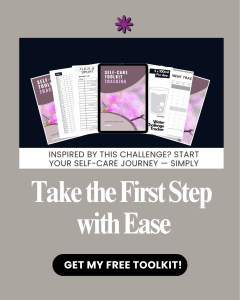
You’ll also receive the free Self-Care Toolkit to help you explore the different pathways and find what supports you best.
As far back as I can remember, the moment I stepped inside a wood, forest, or even a small spinney, I immediately noticed a shift — both in my surroundings and within myself. The tall, cathedral-like acoustics, the soft feel underfoot, and that earthy, grounding scent all seem to whisper, slow down, you’re safe here.
My breathing naturally becomes deeper, and for me, there’s always a feeling of profound inner peace. (Proper footwear helps too — this is the UK, after all, and muddy serenity is still serenity.)
This challenge is about mindfully harnessing that experience — learning how to use your local wood or forest as a natural way to recharge, refresh, and reset.
There are so many different self-care practices that help with stress, and I’ve tried many of them. But forest bathing remains a favourite because it’s simple, deeply restorative, and reconnects you with something far bigger than stress. And if you can’t travel or have mobility challenges, don’t worry — I’ll share ways to create your own garden bathing experience too.
Join me in the woods for a few moments!
What Is Forest Bathing?
Forest Bathing, or Shinrin-yoku, began in Japan in the 1980s as a response to rising stress, anxiety, and fatigue among workers. It’s a mindful sensory practice that helps you slow down and reconnect with nature. You walk or sit quietly among trees, noticing the sounds, sights, scents, and textures that surround you.
In essence, it’s not about doing, but about being — allowing the forest to hold you while you let go of daily noise and demands.
The Science Behind Forest Bathing
Trees release natural compounds called phytoncides — aromatic chemicals that protect them from insects and disease. When we breathe them in, studies show they help lower cortisol levels, reduce inflammation, and support the immune system.
Forest bathing also activates your parasympathetic nervous system — the part that signals rest, repair, and recovery. Just 30 minutes among trees can calm the mind and body, even when life feels chaotic.
When to Try Forest Bathing
You might choose forest bathing when you feel drained, overwhelmed, restless, anxious, or low in mood. It’s equally beautiful when life feels steady — as a way to maintain your inner balance and refresh your energy.
Whether it’s the crisp quiet of winter, the soft greens of spring, the shade of summer, or the glow of autumn, each season brings its own kind of healing.
Prepare for Your Forest Bathing Experience
Choose Your Location.
You don’t need a vast forest — a local wood, park, or even a group of trees can work beautifully.
Plan Ahead: Check the weather and dress for comfort. Let someone know where you’re going if you’ll be alone. Bring water, a small snack, and something dry to sit on. Switch your phone to silent once you arrive — this is your time to disconnect.
Pause for a moment at the entrance. Notice the shift in light, sound, and energy as you step into the trees. If you’re with a friend, agree on a time to meet again, then give each other space to explore quietly.
You might begin with a simple intention, such as: Today I give myself permission to rest or I open myself to peace and renewal.
Your Forest Bathing Plan
Forest bathing usually includes two gentle parts: Slow Walking and a Sit Spot.
Slow Walking
Move slowly — far more slowly than usual. Let yourself pause often and use your senses as guides.
Sight: Notice colours, patterns, and movement.
Sound: Listen for birdsong, rustling leaves, wind through branches.
Smell: Breathe in the earthy scent of soil, bark, or moss.
Touch: Feel textures — the ground under your feet, the bark of a tree, the air on your face.
Mindful Walking: Bring your awareness into your body. Notice how your shoulders, arms, and legs move. When your mind wanders, gently bring it back to what you feel underfoot or the rhythm of your steps.
Tree Connection: You can gently lean against or embrace a tree and simply breathe. It’s a lovely way to connect, release tension, and absorb the grounded calm that trees naturally offer.
Find your Sit Spot
Find a quiet place to sit for 10–30 minutes — a fallen log, a bench, or a picnic mat. Observe everything around you: light, texture, patterns, movement, and sound.
You might choose to journal or sketch what you notice, meditate or pray, enjoy a mindful snack, or simply sit and breathe. There’s no right way to do this — your only goal is to be fully present.
Gratitude Walk Back
As you slowly walk back, take a few moments to reflect. How do you feel now? What did you notice or appreciate? Which tree, plant, or sound stood out to you? End with a small inner thank you — for the forest, for yourself, and for the moment you took to rest.
Garden Bathing(Home Practice)
If you can’t get to a forest, you can still enjoy a mini version of this practice at home. Sit near a tree in your garden or balcony, or near a window with a view of greenery. You can even connect with a houseplant or recently planted tree — research shows that proximity to plants still helps calm the nervous system.
Use the same approach: slow down, breathe, notice, and appreciate.
Final Thoughts
Forest bathing is a beautiful, accessible way to reset your mind and energy — no special skills or travel needed. Try it once a week or even once a month, and notice how you feel before and after. Keep a small journal or voice note to record your reflections.
For me, forest bathing is both restorative and preventative. It helps me reconnect with peace — whether I’m walking under summer leaves or through the quiet, rain-soaked woods of winter. Will you try forest bathing? I’d love to hear what you discover.
Remember, muddy boots and messy hair still count — what matters is that you showed up.
Will you try forest bathing? I’d love to hear what you discover.
Well-done! You have completed another step towards making selfcare simple
You Felt a Small Shift Today… Let’s Help You Keep It
That small shift — whether it was a moment of calm, a little more energy, a sense of relief, or simply feeling more like yourself — that is where meaningful change begins.
But on low-sparkle days, it’s easy to lose that feeling. Motivation dips first. Overwhelm creeps in. And even the gentlest intentions fade.
Your body doesn’t need pressure or perfection. It needs one easy mini practice you can return to — especially on days that feel heavy, uncertain, or tense.
The Free Self-Care Start-Up Toolkit helps you turn “I want to feel better” into one easy, real-life step — by helping you choose and begin a challenge you can actually use when your mood dips. Most people like to complete it over a relaxed weekend, and it includes short step-by-step videos and simple printables to help you begin gently.
✨ Download the Free Self-Care Start-Up Toolkit
A calm, supportive starting point for your first Align & Uplift practice.
Inside, you’ll gently discover how to: 🌿 understand where you might need emotional or energetic support 🌿 choose one tiny Align & Uplift practice that fits your real life 🌿 begin without pressure or relying on willpower 🌿 notice subtle shifts that help you feel lighter and more grounded
You’ll also receive: ✉️ weekly reminders to support your consistency 💬 access to our private community (coming soon)
(Part of the Align & Uplift Pathway — reconnect with calm, joy, and emotional balance)
Real self-care is about listening to yourself. Because being healthy isn’t always easy — but it can be made simple.
Make Self Care Simple shares general self-care education for inspiration only. I’m not providing medical advice — always check what’s right for you with a qualified health professional.
How to Plan your First Forest Bathing Experience – Ready to Recharge & Feel Refreshed.
Print or Save as PDF
Notes
Printable Summary – Forest Bathing “Recipe”
Goal: Recharge, relax, and refresh your energy through mindful time in nature.Duration: 30–60 minutes (or longer if you wish)You’ll need: Comfortable shoes, water, mat or chair, journal, weather-appropriate clothing
Choose a forest, wood, or tree-filled area
Set a simple intention
Walk slowly and use your senses
Find a sit spot to pause and reflect
End with gratitude and appreciation
Feeling inspired? Join the Make Self-Care Simple newsletter for gentle self-care ideas, new challenges, and community support.
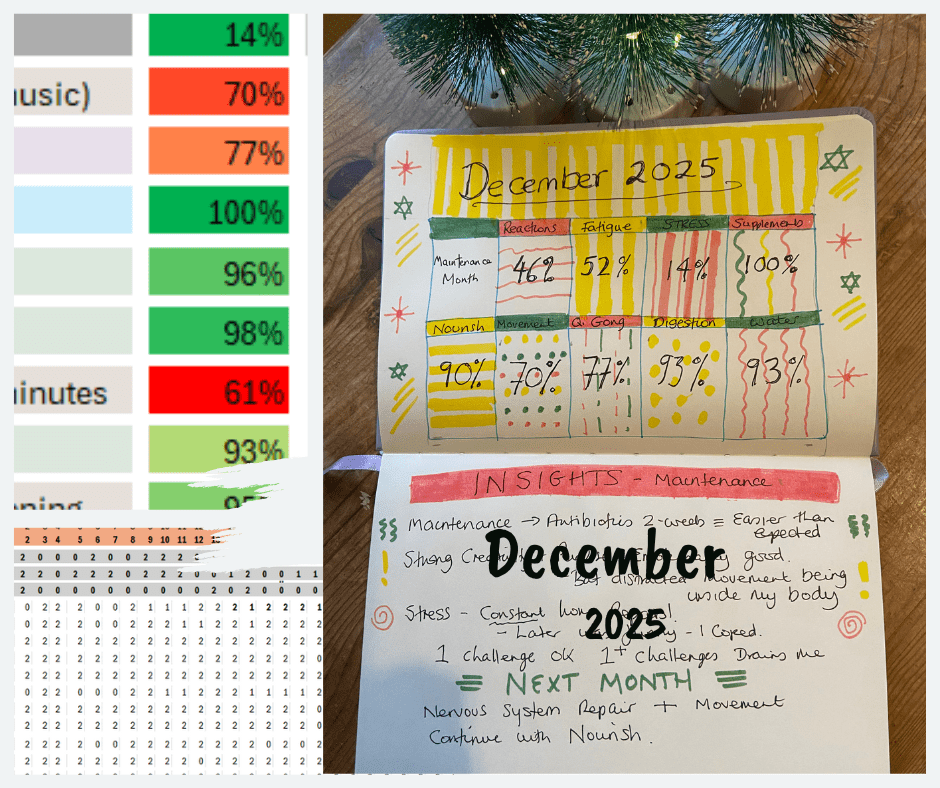
This update is based on the same monthly reflection I use to review my health, life, and self-care — a simple process of noticing what the month has already revealed rather than setting new targets
Hi, it’s Jo
If you’re anything like me, December often isn’t a month for big intentions or shiny new plans. It’s more a month of getting through, holding things steady, as self-care is rarely my main focus.
That’s why I chose maintenance as my theme this month.
I was about to start a two-week course of antibiotics as a SIBO/MCAS treatment and, rather than pushing myself with new self-care challenges, I wanted to give my body space. Fewer demands. More listening. As it turned out, the treatment itself was much easier than expected — which was a useful reminder that anticipation is often harder on the nervous system than the thing itself.
What a maintenance month actually showed me
One thing December made very clear is how differently progress looks in a maintenance phase.
There was no sense of “moving forward” in obvious ways — but there was a sense of not slipping backwards, and that matters more than we often give credit for.
It also highlighted something I’ve noticed before, but always appreciate being reminded of:
Emotional nourishment doesn’t automatically take care of the body.
This month, writing, planning, and working on ideas lifted my mood and gave me direction. Emotionally, that part felt good.
But there was a trade-off.
All that mental and creative energy quietly distracted me from the basics — things like my much needed regular movement self-care. Not in a dramatic way. Just enough to notice, afterwards, that my body had been a bit sidelined while my mind was happily occupied elsewhere.
Having a system to notice these patterns has been so helpful, not as more problems to fix, but to understand how to support myself better moving forward.
A messy (and slightly funny) moment
December also brought a string of home repairs, one after another. No heating. Blocked drains. An extractor fan that chose the worst possible moment to give up.
None of these were disasters on their own — but together they created a series of low-level stress that sits in the body even when you’re trying to be philosophical about it.
At one point I remember thinking, “Of course it’s this as well.” And then laughing, because sometimes that’s the only sensible response.
Those tiny moments — a flicker of humour, a softening — are often what I think of as glimmers: small signals of safety that don’t fix the day, but change how the body carries it.
It was stressful — and oddly funny — and a good example of how practical stress can be far more taxing than emotional drama.
What were your challenges in December?
The pattern that stood out
Looking back, the clearest pattern from December was this:
A series of small, unexpected, unresolved things going wrong (at the same time) drains my system more than I realised
Everyone has months like this. What I noticed was that this drained me more than I expected. That is not a problem, it’s understanding that in these situations my nervous system needs more support. Feedback, then insight this month makes it easier to recognise next time it happens, so I can adjust my self-care support earlier.
That’s useful information. Not a judgement. Just awareness for me to work with.
Tracking doesn’t have to be perfect to be useful. This is simply how I notice patterns before reflectingin a fun easy way
What maintenance supported
By choosing maintenance rather than pushing forward, December quietly supported:
steadier energy overall
fewer exaggerated reactions
better recovery after stress
less pressure to “do self-care properly”
None of this is headline-worthy — but this is often what a supportive month looks like.
Sometimes progress is simply not making things harder than they already are.
What I’m carrying into January2026
December reminded me that there are different seasons of self-care.
Some months are for experimenting. Some are for building. And some are for maintaining and repairing.
Listening to my body each month naturally shows me what the next step should be. Not what is popular or new or fascinating, but which self-care my body needs next.
A quiet closing thought
If you’ve had a month where maintenance felt like all you could manage, you’re not behind.
Holding steady is a skill. Listening instead of pushing is self-care.
I’ll share more next month as things unfold — and as always, take what’s useful and leave the rest.